 Amazon UK
 Amazon US
 Amazon DE
 Amazon FR
 Amazon ES
 Amazon IT
 Amazon JP
 Amazon CA
 Amazon NL
 Amazon AU
 Amazon PL
 Amazon SE
 Amazon BE
 Amazon IE
Symphony No. 5
There is hardly any other piece in classical music as famous as Beethoven's Fifth Symphony. Ask any person on the street about Beethoven, and they will probably start singing the opening notes of the Fifth. Many people know this theme as the music of fate (“Schicksals-Sinfonie”), yet when Beethoven wrote this piece, nothing could have been further from his mind. The byname Fate stems from Beethoven's secretary Anton Schindler, who — long after the composer's death — came up with the legend of “fate knocking at the door.” There is no hint that Beethoven ever spoke or wrote this, and Schindler was known not to be entirely trustworthy; he dramatized many episodes of his relationship with Beethoven, seemingly to make himself more interesting.
But maybe you like the idea of fate knocking at the door, while others, like Beethoven's pupil Czerny, might prefer a more natural image. Or perhaps your idea is something more philosophical. In the end, it is up to you what you hear in this music. Let us simply agree that it is a fantastic symphony, and not an easy one to play. Any orchestra performing the Fifth needs to be on top of its game; full concentration is necessary until the last chord.
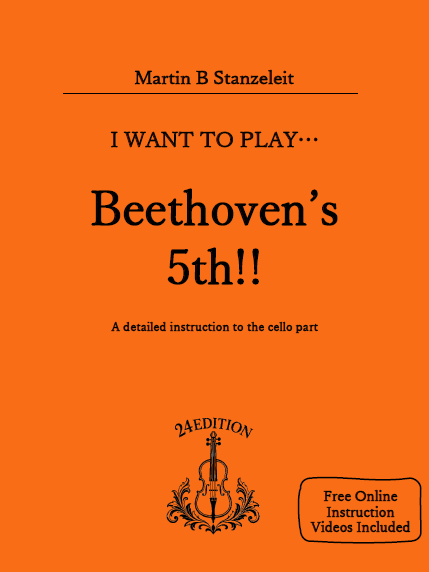
As a cellist, in order to serve your section and react to the conductor's cues while listening to the other instruments, you need to master your part first. Before we begin, there is — as always — a disclaimer: bowings and fingerings may vary enormously depending on the tempo preferred by the conductor. Even within the same tempo, there are many possible ways to play a given passage. If you end up using a different bowing or fingering, that is perfectly fine. However, let us caution you not to diverge from this method without good reason. So — let us get going, shall we?